
Your Music is Everywhere. “Now What?”
Part 1: The Gatekeepers
The Present Day in Music
We live in a genuinely amazing era for making and listening to music.
An artist can write a song in a bedroom, record it without setting foot in a major studio, send it through a distributor, and see it appear beside The Rolling Stones, Bruno Mars, or Tool on the same global streaming services.
The first time that happens to you, it can make your brain short-circuit a little. It should. For most of music history, that kind of access would have been almost unthinkable.
But the miracle hides a problem:
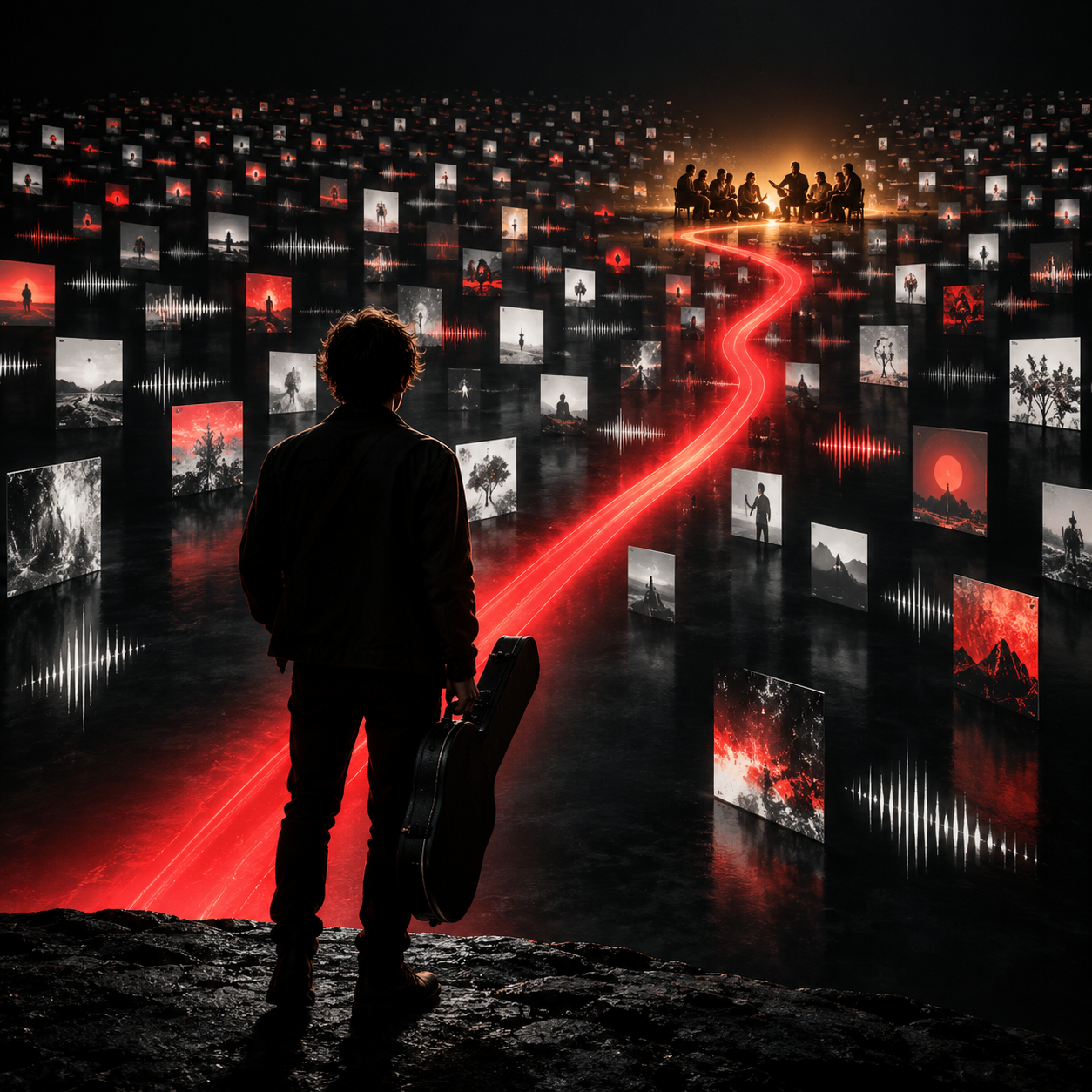
Being available everywhere is not the same as being discovered anywhere.
The Old Gatekeepers Controlled Access
Independent artists did not suddenly appear with the internet. Punk bands, jazz musicians, hip-hop crews, electronic producers, folk singers, and small labels were recording and selling their own music long before streaming.
What they usually did not have was access at scale.
If you wanted a release to reach a national or international audience, the dominant routes ran through record labels, physical manufacturing, wholesale distribution, record stores, commercial radio, the music press, and television. A label could finance recording, manufacture records, put them into stores, hire publicists, work radio, and fund a music video. Those relationships—and the money required to activate them—were the moat.
That did not mean every successful artist had a major-label contract. It meant that mass reach usually required cooperation from institutions that controlled scarce channels.
Labels were not charities, either. Advances were generally recoupable, contracts divided ownership and royalties, and an artist who stopped looking profitable could quickly stop being a priority. The label took risk, but it also negotiated for the upside.
Radio and MTV were powerful because audiences had relatively few places to go. A programmer, DJ, critic, retailer, or label executive could place a record in front of millions of people. Human taste mattered—but access to those humans was itself a gate.
Distribution Became Democratic
Digital recording and distribution broke that system all but wide open.
By 2022, Apple Music said its catalog had passed 100 million songs, that artists could release globally across 167 countries and regions, and that more than 20,000 singers and songwriters were delivering new music to the service every day. Apple called the change evidence of a more democratic music economy. It was right. (Apple)
Today, an independent artist with a finished master, usable artwork, accurate metadata, and a modest distribution budget can reach the major streaming platforms without persuading a record-label executive first.
That is a historic victory.
It also created the next problem…
Everybody got the Memo
According to figures from Luminate’s 2025 Year-End Music Report, streaming services ended 2025 with roughly 253 million tracks. An average of 106,000 new tracks were delivered to services every day, up 7% from 2024. Nearly 88% of available tracks received 1,000 streams or fewer during the year. (Luminate report; Music Business Worldwide summary)
That does not mean independent music is doomed. It means distribution solved the problem of access to the shelf. It did not solve the problem of getting someone to choose your record from the shelf.
The audience is enormous. IFPI reports that global recorded-music revenue reached $31.7 billion in 2025, with streaming accounting for 69.6% of the total. Paid subscription accounts reached 837 million worldwide. (IFPI Global Music Report 2026)
Independent artists are participating in that growth. Spotify reports that independent artists and labels generated about half of its royalties in 2025, and that more than a third of artists generating at least $10,000 on Spotify were DIY or began their careers by self-releasing. Those are Spotify’s own figures, so they should be read as platform-reported data, but they still document a real path that barely existed at this scale in the old system. (Spotify Loud & Clear)
In short: the market is oversaturated.
The Gatekeepers Didn’t Disappear – They Moved
The old gatekeepers controlled whether your record could reach the market. The new gatekeepers influence whether anyone notices it once it gets there.
Some are human: playlist editors, journalists, DJs, bookers, music supervisors, scene organizers, and fans with trusted taste.
Some are algorithmic: recommendation systems deciding which songs to test in Radio, Autoplay, Mixes, or other personalized spaces.
And one of the biggest gatekeepers is simply…attention.
Every artist is competing not only with other new releases, but with the entire history of recorded music, video platforms, games, podcasts, group chats, and everything else asking for a listener’s time.
Spotify says more than half of new-artist discoveries on its platform happen in programmed playlists, a category that includes editorial and personalized recommendations. Apple says human curation remains central to both its visible editorial playlists and the human input behind its recommendations. (Spotify for Artists; Apple)
The machine matters. The human still matters. The two are connected—but not in the way some music-marketing pitches claim.
Part 2 of this article coming soon…